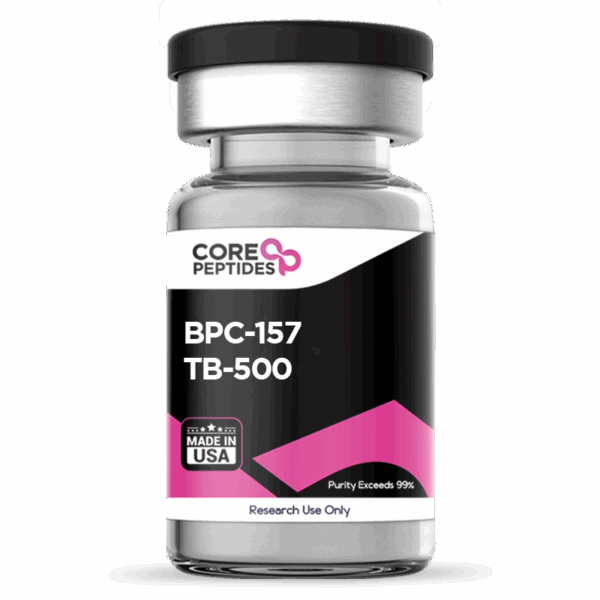
BPC-157 & TB-500 Blend (10mg/20mg)
Price range: $105.00 through $195.00
Size: 10mg/20mg
Contents: BPC-157 5mg/10mg, TB-500 (thymosin beta 4) 5mg/10mg
Form: Lyophilized powder
Purity: >99%
SKU: P-BPC157TB500
FREE Shipping on $200+ orders
| Quantity | Discount | Price |
|---|---|---|
| 5 – 8 | 5% | Price range: $99.75 through $185.25 |
| 9 + | 10% |
BPC-157 & TB-500 Peptide Blend – Research Overview
The BPC-157 & TB-500 Blend combines two of the most widely researched cytoprotective and tissue-regenerative peptides into a single analytical framework.
-
BPC-157 (Body Protection Compound-157) is a stable, 15-amino-acid gastric-derived pentadecapeptide known for its organo-protective properties, extracellular matrix assembly capabilities, and angiogenic potential.
-
TB-500 (Synthetic Thymosin Beta-4) is a 43-amino-acid synthetic variant of endogenous thymosin (), an actin-sequestering protein heavily expressed in the thymus that dictates cell migration, survival, and physiological repair.
While no published clinical trials have evaluated these molecules inside a singular co-administered compound, researchers frequently investigate the blend to observe potential synergistic cross-talk. It is hypothesized that the combined mechanisms may accelerate musculoskeletal tissue engineering, wound closure, and structural remodeling faster than either isolated sequence alone.
Quick Chemical Profile
Mechanistic Pathways & Synergy Profile
TB-500: Actin-Cytoskeleton Regulation and Anti-Inflammation
TB-500 exerts its primary therapeutic influence by controlling cellular motility through interactions with G-actin (globular actin monomers):
-
The Binding Domain: TB-500 contains a distinct, highly conserved amino acid segment spanning residues 17 to 23 (). This specific domain binds and sequesters G-actin, accelerating its polymerization into F-actin (filamentous actin). This dynamic shift restructures the cellular cytoskeleton, driving immediate cell migration to injured regions to speed up wound closure.
-
Pro-Inflammatory Cytokine Suppression: On a molecular level, TB-500 dramatically up-regulates microRNA-146a (miR-146a). This microRNA acts as an epigenetic repressor that down-regulates interleukin-1 receptor-associated kinase 1 (IRAK1) and tumor necrosis factor receptor-associated factor 6 (TRAF6), checking the systemic inflammatory cascade.
BPC-157: Angiogenesis and Extracellular Matrix Assembly
BPC-157 operates downstream to construct the physical matrix needed for newly mobilized cells to settle:
-
Endothelial Protection: BPC-157 interfaces with endogenous nitric oxide (NO) generation systems to shield vascular walls and boost localized neoangiogenesis (the formation of new blood vessels).
-
Gene Activation & Collagen Synthesis: The peptide drives the expression of the Early Growth Response 1 () gene. This activation increases the production of healing cytokines and growth stimuli, triggering structural collagen deposition to build a healthy extracellular matrix.
Primary Research & Preclinical Insights
1. Accelerated Dermal Wound Healing
Preclinical trials highlighting both peptides show remarkable efficacy in restoring epithelial integrity:
-
TB-500 Performance: In wounded murine models, TB-500 administration generated a 41% increase in re-epithelialization (the growth of new epithelial cells over a wound) within 4 days. By day 7, absolute wound contraction advanced by an extra 11% compared to control groups.
-
Human Clinical Data: A randomized, double-blind Phase II clinical trial involving 72 human subjects with chronic pressure ulcers confirmed that standardized administration of significantly reduced absolute ulcer size and accelerated tissue normalization over an 84-day window.
-
BPC-157 Performance: Histological reviews of acute and chronic dermal injuries treated with BPC-157 confirmed dense clusters of newly formed blood vessels and structured collagen bands, outpacing standard control baselines.
2. Ligament and Tendon Remodeling
Soft tissue structural integrity depends heavily on cell migration and fiber diameter, which both components of this blend appear to directly enhance:
-
Collagen Realignment: In surgical models involving full transections of the medial collateral ligament (MCL), subjects exposed to TB-500 showed wider, more evenly spaced, and uniformly aligned collagen strands after 4 weeks. This structural improvement directly boosted the load-bearing capacity of the femur-MCL-tibia complex.
-
Fibroblast Proliferation: In vitro transwell filter assays show that BPC-157 drives the rapid dispersion and migration of tendon fibroblasts. It achieves this by activating the FAK-paxillin pathway, drastically increasing the phosphorylation rates of Focal Adhesion Kinase (FAK) and paxillin to help cells withstand intense oxidative stress.
3. Muscle Regeneration and Protective Dynamics
Both components exhibit profound protective properties in skeletal and cardiac muscle tissues under metabolic strain:
-
Corticosteroid Degradation Counteraction: Long-term corticosteroid exposure is known to stall tissue repair and cause muscle wasting. In murine models with crushed gastrocnemius muscles, daily administration of BPC-157 for 14 days completely neutralized methylprednisolone-induced muscle atrophy, restoring full structural and functional capacity.
-
Myocardial Ischemia Defenses: TB-500 preserves cardiac muscle tissue during periods of severe hypoxia (low oxygen). The peptide up-regulates Integrin-Linked Kinase (ILK) and Protein Kinase B (Akt) pathways within the heart, allowing native cardiac fibroblasts to transition into cardiomyocyte-like cells, which maintains early cell survival and optimizes post-ischemic cardiac output.
Why Choose Us for BPC-157 & TB-500 Blend?
When purchasing a high-affinity BPC-157 & TB-500 Peptide Blend for analytical applications, maintaining an exact, uncompromised molecular ratio is essential for valid experimental outcomes.
-
Optimized Co-Lyophilization: Our custom blend undergoes a specialized co-lyophilization (freeze-drying) process that pairs both peptide chains into a uniform compound, ensuring balanced distribution across all research aliquots.
-
Validated Purity Frameworks: Every production batch undergoes strict High-Performance Liquid Chromatography (HPLC) and Mass Spectrometry (MS) mapping to guarantee chemical purity profiles exceeding 99%.
-
Sterile Structural Stability: Our manufacturing processes eliminate moisture contamination and structural degradation, ensuring long-term peptide stability under climate-controlled research conditions.
For verified high-purity compounds, secure documentation, and optimized ordering configurations, visit Peptide Shop AU.
Section 621 Disclaimer
BPC-157 & TB-500 Peptide Blend is available strictly for research and laboratory purposes only. It is not approved for human consumption, diagnostic, therapeutic, or clinical use. Please thoroughly review and adhere to our verified Terms and Conditions before completing your order.
Referenced Literature
-
Seiwerth, S., et al. (2021). Stable Gastric Pentadecapeptide BPC 157 and Wound Healing. Frontiers in Pharmacology, 12, 627533.
-
Maar, K., et al. (2021). Utilizing Developmentally Essential Secreted Peptides Such as Thymosin Beta-4… Cells, 10(6), 1343.
-
National Center for Biotechnology Information. PubChem Compound Summary for CID 132558700 (TB-500) & CID 9941957 (BPC-157).
-
Gurtner, G. C., et al. (2008). Wound repair and regeneration. Nature, 453(7193), 314-21.
-
Santra, M., et al. (2014). Thymosin up-regulation of microRNA-146a promotes oligodendrocyte differentiation and suppression of the Toll-like proinflammatory pathway. The Journal of Biological Chemistry, 289(28), 19508–19518.
-
Sikiric, P., et al. (2016). Brain-gut Axis and Pentadecapeptide BPC-157: Theoretical and Practical Implications. Current Neuropharmacology, 14(8), 857-865.
-
Chang, C. H., et al. (2011). The promoting effect of pentadecapeptide BPC-157 on tendon healing involves tendon outgrowth, cell survival, and cell migration. Journal of Applied Physiology, 110(3), 774-80.
-
Malinda, K. M., et al. (1999). Thymosin Accelerates Wound Healing. Journal of Investigative Dermatology, 113(3), 364-368.
-
ClinicalTrials.gov. Study of Thymosin Beta 4 in Patients With Pressure Ulcers. Identifier: NCT00382174.
-
Seiwerth, S., et al. (1997). BPC-157’s effect on healing. Journal of Physiology, Paris, 91(3-5), 173-8.
-
Xu, B., et al. (2013). Thymosin enhances the healing of medial collateral ligament injury in rat. Regulatory Peptides, 184, 1-5.
-
Pevec, D., et al. (2010). Impact of pentadecapeptide BPC-157 on muscle healing impaired by systemic corticosteroid application. Medical Science Monitor, 16(3), BR81-88.
-
Srivastava, D., et al. (2012). Cardiac repair with thymosin and cardiac reprogramming factors. Annals of the New York Academy of Sciences, 1270, 66–72.
-
Bock-Marquette, I., et al. (2004). Thymosin beta4 activates integrin-linked kinase and promotes cardiac cell migration, survival and cardiac repair. Nature, 432(7016), 466–472.
Medical Reviewer: Dr. Marinov (MD, PhD), Chief Assistant Professor in Preventive Medicine & Public Health. Expert in Evidence-Based Medicine, Myocardial Remodeling, and Synergistic Peptide Therapy.
Be the first to review “BPC-157 & TB-500 Blend (10mg/20mg)”
Related products
Peptides
Reviews
There are no reviews yet.