
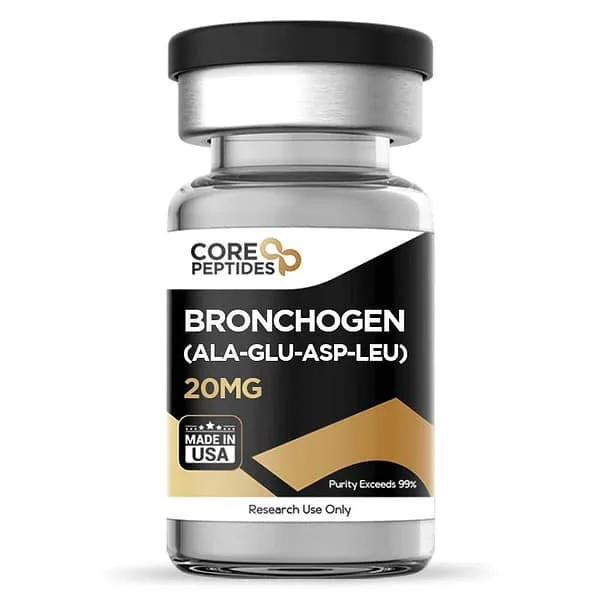

Bronchogen Peptide (AEDL) – Research Overview
Bronchogen (scientifically designated as AEDL) is a short, synthetic signaling peptide belonging to the Khavinson peptide family. Functioning as an epigenetic bioregulator, Bronchogen is capable of penetrating cellular and nuclear membranes to interact directly with DNA structures. Current research focuses heavily on its tissue-specific affinity for respiratory structures, exploring its ability to modulate genetic pathways linked to cell renewal, inflammatory response, and structural tissue remodeling within the lungs. Buy Bronchogen lung bioregulator peptide if needed.
Quick Chemical Profile
-
Molecular Formula: $C_{18}H_{30}N_{4}O_{9}$
-
Molecular Weight: 446.45 g/mol
-
Peptide Sequence: Ala-Glu-Asp-Leu (AEDL)
-
Application: Laboratory Research Use Only
Primary Research & Clinical Insights
1. Epigenetic DNA Interaction & Stabilization
Bronchogen exerts its primary biological effects by regulating gene expression specific to pulmonary structures. Researchers have mapped two distinct pathways of genetic interaction:
-
Gene Expression Regulation: Studies show Bronchogen exhibits high affinity for lung tissue, directly regulating the expression of key respiratory genes, including NKX2-1, SCGB1A1, SCGB3A2, FOXA1, and FOXA2. This regulation is linked to reduced inflammation and altered cellular differentiation.
-
Epigenetic Methylation Modulator: Early models suggested that AEDL preferentially binds to deoxyribooligonucleotides containing CNG sequences—prime targets for cytosine DNA methylation in eukaryotes. By binding to these sites, the peptide may prevent epigenetic gene silencing.
-
Thermal Stability Enhancement: Differential scanning microcalorimetry trials on mammalian DNA show that Bronchogen acts as a nonselective stabilizing agent. The peptide binds non-covalently across both DNA strands via hydrogen bonding and van der Waals forces, elevating the DNA melting temperature by 3.1 °C.
2. Bronchial Cell Renewal & Epithelial Function
Preclinical in vitro data highlights Bronchogen’s capacity to serve as an efficient catalyst for lung tissue regeneration.
Research indicates that the peptide selectively binds to the guanine N7 site of target DNA sequences without warping or disrupting the structural integrity of the double helix. This subtle, targeted engagement stimulates the replication, proliferation, and functional activity of bronchial epithelial cells, making it a primary asset for experimental targeted delivery systems and cellular renewal research.
3. Mitigation of Chronic Pulmonary Inflammation
To evaluate its impact on compromised respiratory barriers, researchers deployed Bronchogen in murine models experiencing severe bronchial damage from prolonged nitrogen dioxide ($NO_2$) exposure:
-
Inflammatory Cascade Intervention: Presentation of the peptide effectively suppressed neutrophilic inflammation in the bronchoalveolar space, restoring a balanced profile of pro-inflammatory cytokines and enzymes.
-
Local Immunity Boost: Bronchogen induced a structural rejuvenation of the bronchial epithelium, marked by a sharp increase in secretory immunoglobulin A (sIgA)—a critical biomarker for local mucosal immunity.
-
Alveolar Surfactant Balance: The peptide up-regulated surfactant protein B, which plays an essential role in reducing alveolar surface tension and preserving vital lung defenses.
4. Reversal of Tissue Remodeling and Fibrosis
Chronic respiratory strain typically forces the pulmonary matrix into pathological restructuring. In 60-day intermittent exposure models, Bronchogen successfully counteracted and reversed key structural symptoms of lung tissue remodeling:
-
Metaplasia and Hyperplasia Abatement: The compound significantly reduced goblet cell hyperplasia, squamous metaplasia, lymphocytic infiltration, and emphysema.
-
Ciliated Cell Restoration: Treated tissue profiles demonstrated a distinct restoration of functional ciliated cells along the respiratory lining.
-
Systemic Secondary Actions: Beyond lung-specific repair, ongoing secondary models imply that Bronchogen’s anti-inflammatory behavior may minimize downstream hemodynamic disturbances and decrease myocardial hypertrophy under stress conditions.
Section 621 Disclaimer
Bronchogen (AEDL) is available strictly for research and laboratory purposes only. It is not approved for human consumption, therapeutic, or clinical use. Please thoroughly review and adhere to our verified Terms and Conditions before completing your order.
Referenced Literature
-
Khavinson, V. K., et al. (2021). Peptide Regulation of Gene Expression: A Systematic Review. Molecules, 26(22), 7053.
-
Fedoreyeva, L. I., et al. (2011). Penetration of short fluorescence-labeled peptides into the nucleus… Biochemistry (Moscow), 76(11), 1210–1219.
-
Khavinson, V. K., et al. (2012). Peptides tissue-specifically stimulate cell differentiation during their aging. Bulletin of Experimental Biology and Medicine, 153(1), 148–151.
-
Monaselidze, J. R., et al. (2011). Effect of the peptide bronchogen (Ala-Asp-Glu-Leu) on DNA thermostability. Bulletin of Experimental Biology and Medicine, 150(3), 375–377.
-
Morozova, E. A., et al. (2017). In vitro interaction of the AEDL peptide with DNA. Journal of Structural Chemistry, 58, 420-424.
-
Kuzubova, N. A., et al. (2015). Modulating Effect of Peptide Therapy on the Morphofunctional State of Bronchial Epithelium… Bulletin of Experimental Biology and Medicine, 159(5), 685–688.
Medical Reviewer: Dr. Marinov (MD, Ph.D.), Chief Assistant Professor in Preventive Medicine & Public Health. Specialist in Evidence-Based Medicine, Epigenetic Peptide Bioregulators, and Nutrition.
Be the first to review “Bronchogen (20mg)”
Related products


Peptides


Peptides
Reviews
There are no reviews yet.