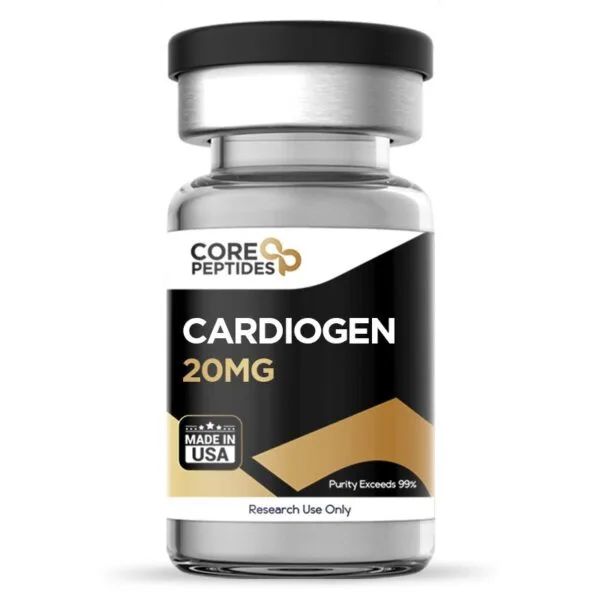
What is the Cardiogen Peptide?
Cardiogen is a synthetic tetrapeptide classified as a Khavinson peptide bioregulator. It is primarily studied for its highly selective, tissue-dependent regulatory effects on fibroblasts and cardiomyocytes (heart muscle cells). By modulating cellular signaling cascades, Cardiogen displays a dual mechanism of action: inhibiting programmed cell death (apoptosis) in ischemic cardiac tissue while stimulating necrosis and apoptosis within malignant tumor vascular networks.
Quick Chemical Profile
-
Molecular Formula: $C_{18}H_{31}N_{7}O_{9}$
-
Molecular Weight: 489.5 g/mol
-
Peptide Structure: H-Ala-Glu-Asp-Arg-OH
-
Other Known Titles: SCHEMBL3194515
-
Application: Laboratory Research Use Only
Primary Research & Clinical Insights
1. Dual Action in Oncology: Selective Tumor Apoptosis
While Cardiogen acts as an apoptotic protectant in healthy heart tissue, preclinical research demonstrates an opposite, disruptive impact on malignant structures:
-
Vascular-Mediated Tumoral Necrosis: In murine models presenting with metastatic M-1 sarcoma, Cardiogen administration resulted in significant, dose-dependent tumor growth inhibition.
-
Mechanistic Selectivity: Morphological data indicate the peptide does not exert a direct cytostatic effect on tumor cells. Instead, it selectively targets the atypical, hyper-proliferative vascular networks supplying tumors, triggering localized hemorrhagic necrosis and accelerated tumor cell apoptosis.
2. Cardiomyocyte Protection & Post-Ischemia Survival
Cardiogen is widely researched for its potential to optimize long-term cardiac remodeling by stimulating cardiomyocyte proliferation while simultaneously suppressing excessive fibroblast proliferation (scar tissue formation).
-
Downregulation of p53: Immunohistochemical studies reveal that Cardiogen actively decreases the expression of the p53 protein (a key apoptotic initiator) in myocardial tissue. This reduction preserves cardiac tissue integrity in both young and aged specimens following injury.
-
Threefold Mortality Reduction: In experimental myocardial infarction models (induced via coronary artery ligation), Cardiogen presentation led to a 3x decrease in mortality compared to control groups.
-
Ischemic Tissue Preservation: Research notes a distinct reduction in necrotic zones, the preservation of cellular energy reserves via sustained glycogen content, and enhanced mitochondrial membrane protection post-ischemia.
3. Cytoskeletal and Nuclear Matrix Regulation
In vitro research using embryonic fibroblast models shows that Cardiogen rapidly penetrates the cell cytoplasm, nucleus, and nucleolus, potentially altering gene transcript accessibility by protecting DNA fragments from endonuclease breakdown.
Following a 30-minute exposure to Cardiogen, researchers documented a 2x to 5x increase in critical structural proteins compared to controls:
-
Cytoskeletal Reinforcement: Drastic upregulation of actin (microfilaments managing cell shape), vimentin (intermediate filaments supplying mechanical resilience under physical stress), and tubulin (microtubules directing intracellular transport).
-
Nuclear Architecture Support: Enhanced expression of nuclear matrix proteins lamin A and C, which reinforce the inner nuclear envelope and organize chromatin for proper gene transcription.
4. Reversal of Cellular Aging in Prostate Fibroblasts
Fibroblast differentiation signaling factors naturally decline in senescent (aging) tissues, leading to structural organ dysfunction. In clinical cell culture models, Cardiogen successfully intervened in the cellular aging profile of human prostate cells. The peptide restored the expression of key signaling markers to youthful levels, marking it as a prime candidate for research surrounding age-related prostate pathologies.
Section 621 Disclaimer
Cardiogen is available strictly for research and laboratory purposes only. It is not approved for human consumption, therapeutic, or clinical use. Please thoroughly review and adhere to our verified Terms and Conditions before completing your order.
Referenced Literature
-
Levdik, N. V., & Knyazkin, I. V. (2009). Tumor-modifying effect of cardiogen peptide on M-1 sarcoma in senescent rats. Bulletin of Experimental Biology and Medicine, 148(3), 433-436.
-
Kheĭfets, O. V., et al. (2010). Peptidergic regulation of the expression of signal factors of fibroblast differentiation in the human prostate… Advances in Gerontology, 23(1), 68-70.
-
Khavinson, V. K., et al. (2012). Tetrapeptide H-Ala-Glu-Asp-Arg-OH stimulates expression of cytoskeletal and nuclear matrix proteins. Bulletin of Experimental Biology and Medicine, 153(4), 559–562.
-
Grieco, P., & Gomez-Monterrey, I. (2019). Natural and synthetic peptides in cardiovascular diseases: An update. Archives of Biochemistry and Biophysics, 662, 15-32.
-
Chalisova, N. I., et al. (2009). The effect of amino acids and cardiogen on the development of myocard tissue culture… Advances in Gerontology, 22(3), 409–413.
-
Khavinson, V., et al. (2022). Senescence-Associated Secretory Phenotype of Cardiovascular System Cells and Inflammaging. Cells, 12(1), 106.
Medical Reviewer: Dr. Marinov (MD, Ph.D.), Chief Assistant Professor in Preventive Medicine & Public Health. Expert in Evidence-Based Medicine, Myocardial Remodeling, and Peptide Bioregulators.
Note: If you want to buy Cardiogen cardiac bioregulator peptide, buy it from a trusted source. The peptide shop is the best for it.
Be the first to review “Cardiogen (20mg)”
Related products
Reviews
There are no reviews yet.