
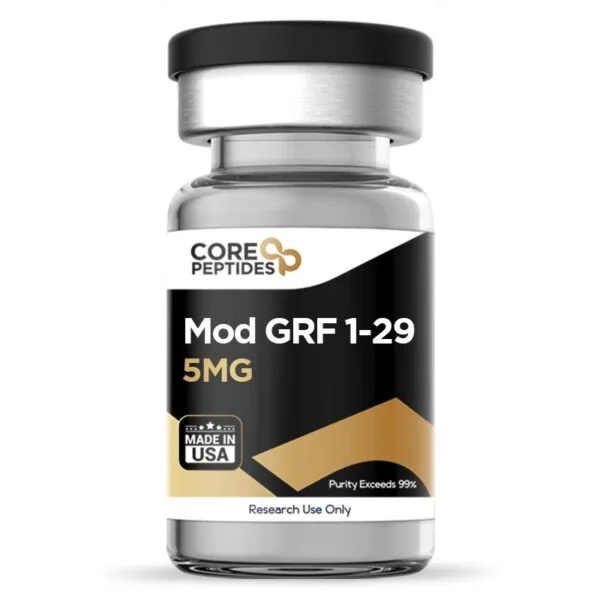
CJC-1295 NO DAC (5 mg) Peptide
CJC-1295 NO DAC (also known as Modified GRF 1-29) is a synthetic, 29-amino-acid peptide analog that mirrors the actions of endogenous growth hormone-releasing hormone (GHRH). [1] First discovered during the early 1980s, research demonstrated that this specific 29-amino-acid cluster retains the full functional capacity and receptor affinity of the naturally occurring 44-amino-acid GHRH peptide sequence. [3]
Unlike its counterpart with a Drug Affinity Complex (DAC), CJC-1295 NO DAC does not bind permanently to plasma proteins. Instead, it is specifically engineered to simulate natural, pulsatile growth hormone release, making it ideal for experimental designs requiring sharp, clean spikes in baseline growth hormone levels rather than prolonged elevation.
Core Research Areas
-
Growth Hormone Activation: Targets pituitary GHRH receptors to spark intracellular signaling cascades that directly stimulate growth hormone (GH) transcription and release. [5]
-
Anabolic & Composition Shifts: Investigated for its potential to accelerate lean muscle tissue hypertrophy and promote net lean mass accumulation. [7]
-
Skin & Tissue Restoration: Associated with increases in skin tissue thickness, potentially driven by the anabolic impacts of the GH-IGF-1 axis on collagen-producing fibroblasts. [7]
-
Cardiovascular Support: Preliminary animal models suggest Modified GRF 1-29 variants may support cardiac tissue repair and improve ejection fraction rates following myocardial injury. [9]
Chemical Specifications
-
Molecular Formula: $C_{152}H_{252}N_{44}O_{42}$
-
Molecular Weight: 3367.9 g/mol
-
Synonyms: Modified GRF 1-29, CJC-1295 Without DAC, Tetrasubstituted GRF 1-29
Key Scientific Findings & Mechanism of Action
1. Advanced Structural Stability
Natural GHRH possesses a fleeting half-life of just a few minutes. To overcome rapid enzymatic breakdown by dipeptidyl peptidase-4 (DPP-4), CJC-1295 NO DAC features four strategic amino acid substitutions that bolster chemical stability while fully retaining biological activity: [4]
| Position | Original Amino Acid | Substituted Amino Acid | Primary Research Purpose |
| 2nd | L-alanine | D-alanine | Prevents immediate enzymatic cleavage and molecular degradation |
| 8th | Asparagine | Glutamine | Minimizes spatial reconfiguration and unintended amide hydrolysis |
| 15th | Glycine | Alanine | Enhances binding affinity and metabolic bioactivity |
| 27th | Methionine | Leucine | Mitigates the risk of methionine oxidation |
2. Maximizing the GH-IGF-1 Axis
Data from structural research models (such as landmark trials by Khorram et al.) show that modifying the GRF 1-29 sequence can yield significant systemic endocrine shifts:
-
GH Secretion: An approximate 70% to 107% increase in mean 12-hour growth hormone release via somatotroph activation in the anterior pituitary. [7]
-
IGF-1 Elevation: A concurrent 28% boost in circulating insulin-like growth factor-1 (IGF-1) functionality. [7]
-
Lean Mass Translation: These elevated biomarkers culminated in a net lean mass increase of 2.77 lbs within the treated research groups. [7]
3. Synergistic Blends & Ghrelin Mimetics
Because CJC-1295 NO DAC is a short-acting GHRH analog, it is widely utilized in research alongside growth hormone secretagogues (GHSs) like Ipamorelin.
While CJC-1295 targets the GHRH receptor, ghrelin mimetics simultaneously activate independent ghrelin receptors on the same pituitary somatotroph cells. [11] Research suggests that concurrent activation of both pathways results in a synergistic amplification of growth hormone synthesis, producing a response significantly greater than either peptide can achieve alone.
Product Note: CJC-1295 NO DAC peptide is manufactured and supplied strictly for research and laboratory purposes only. It is not intended for human diagnostic or therapeutic use. Please review and adhere to our Terms and Conditions before finalizing your order.
References
-
PubChem Compound Summary for CID 91976842, “CJC1295 Without DAC.” National Center for Biotechnology Information.
-
Clark RG, Robinson IC. Growth induced by pulsatile infusion of an amidated fragment of human growth hormone-releasing factor… Nature. 1985.
-
The Discovery of Growth Hormone-Releasing Hormone: An Update. Journal of Neuroendocrinology. 2008.
-
Martin B, et al. Class II G protein-coupled receptors and their ligands in neuronal function and protection. Neuromolecular medicine. 2005.
-
Newton AC, et al. Second Messengers. Cold Spring Harbor Perspectives in Biology. 2016.
-
Khorram O, Laughlin GA, Yen SS. Endocrine and metabolic effects of long-term administration of [Nle²⁷]growth hormone-releasing hormone-(1-29)-NH₂… The Journal of Clinical Endocrinology and Metabolism. 1997.
-
Ito T, et al. GI side effects of a possible therapeutic GRF analogue in monkeys are likely due to VIP receptor agonist activity. Peptides. 2001.
-
Schally AV, et al. Actions and Potential Therapeutic Applications of Growth Hormone-Releasing Hormone Agonists. Endocrinology. 2019.
-
Sinha DK, et al. Beyond the androgen receptor: the role of growth hormone secretagogues in the modern management of body composition… Translational Andrology and Urology. 2020.
Medical Reviewer: Dr. Marinov (MD, Ph.D.), chief assistant professor in preventive medicine & public health, specializing in peptide therapy research.
Be the first to review “CJC-1295 NO DAC (Mod GRF 1-29) (5mg)”
Related products
Reviews
There are no reviews yet.