
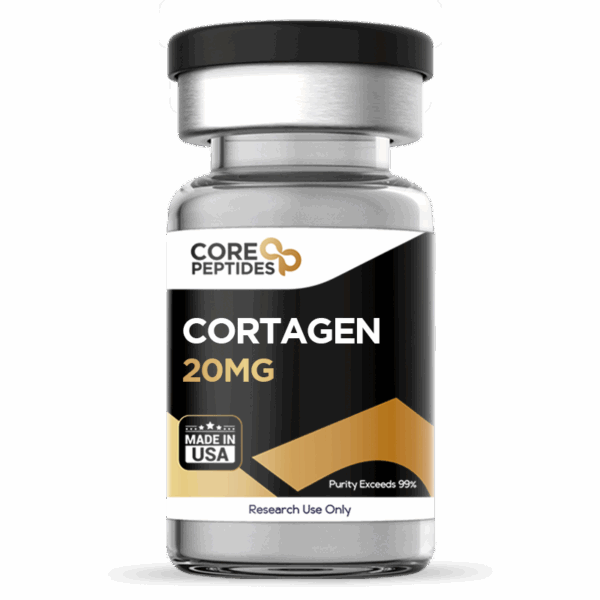
Why Choose Us for Cortagen Peptide?
When sourcing high-purity Cortagen cortex bioregulator peptides for your laboratory, precision and reliability are non-negotiable. Australian researchers demand materials that deliver reproducible, undeniable results.
-
Uncompromised Chemical Purity: Every batch of our synthetic tetrapeptide (Ala-Glu-Asp-Pro) undergoes strict quality control, ensuring exact molecular specifications ($430.4\text{ g/mol}$) for flawless in vitro replication.
-
Streamlined Australian Logistics: Skip the standard international customs headache. We provide fast, reliable, and temperature-controlled shipping directly to Australian universities, laboratories, and private research facilities.
-
Scientific Transparency: We don’t just sell peptides; we back them with peer-reviewed data. Our products align perfectly with the rigorous standards expected by Aussie biomedical professionals.
Product Overview: The Power of Khavinson Bioregulators
Cortagen is a premier synthetic tetrapeptide structurally modeled after the natural polypeptide complexes found in cortexin. Developed within the renowned family of Khavinson peptides, this low-molecular-weight bioregulator does not act as a blunt receptor agonist or enzyme inhibitor. Instead, it is designed to penetrate mammalian cells, reach the nucleus, and directly interface with DNA and chromatin structures to modulate endogenous regulatory systems.
For laboratory settings exploring cellular longevity, epigenetic modification, and neuroregeneration, Cortagen serves as an advanced tool for unlocking complex genetic pathways.
Chemical Profile & Specifications
For precise assay formulation, our Cortagen peptide meets the following strict molecular criteria:
| Parameter | Specification |
| Other Known Titles | AEDP, Ala-Glu-Asp-Pro, Cortagen Cortex Bioregulator Peptide |
| Molecular Formula | $\text{C}_{17}\text{H}_{26}\text{N}_4\text{O}_9$ |
| Molecular Weight | $430.4\text{ g/mol}$ |
| Structure | Short-chain synthetic tetrapeptide |
Core Research Areas & Clinical Potential
1. Epigenetic Regulation & Chromatin Decondensation
Data published by Lezhava et al. highlights Cortagen’s profound epigenetic potential within aged mammalian cell models.
-
The Mechanism: In lymphoid cell cultures exhibiting aged profiles, Cortagen application demonstrated the ability to induce “unrolling” or decondensation of total heterochromatin.
-
The Result: Differential scanning calorimetry revealed that higher-order chromatin structures (such as 30-nm fibers) relaxed into active 5-nm filaments. This targeted relaxation reactivates previously suppressed ribosomal gene clusters, theoretically restoring protein synthesis capacity back to youthful baselines.
2. Advanced Mitigation of Oxidative Cellular Stress
Research led by Kozina et al. indicates that Cortagen operates as a highly sophisticated, indirect antioxidant within neural cell circuits.
-
Lipid & Protein Protection: In integrated biological models, Cortagen exposure was associated with a 15% reduction in protein carbonyl groups within the extracellular fraction, alongside a significant decrease in lipid peroxidation (LPO) products.
-
Upstream Modulation: Because it does not act as a simple, blunt radical scavenger, evidence suggests Cortagen uniquely alters how cell networks handle oxidative stress upstream, protecting delicate neural structures from downstream decay.
3. Transcriptome Modulation & Pluripotent Differentiation
When evaluated via transcriptome-wide analysis (such as the landmark mouse heart tissue studies by Anisimov et al.), Cortagen demonstrated an exceptional capacity to regulate vital cellular stress responses:
-
Mitochondrial & Bioenergetic Support: Up-regulated critical mitochondrial genes ($\text{16S rRNA}$, $\text{COX3}$, $\text{ND5}$), directly influencing excitation-contraction coupling pathways and cellular energy.
-
Survival Signaling: Increased the expression of key stress-response genes ($\text{Pass1}$, $\text{Hsc70}$) and survival signals ($\text{Bmp2}$, $\text{Wnt4}$).
-
Cellular Differentiation: In pluripotent embryonic ectodermal tissue (Khavinson et al.), a brief 1-hour incubation with Cortagen altered the cell trajectory entirely—inducing the tissue to differentiate into both epidermal and mesenchymal pathways, whereas control groups yielded only atypical epidermis.
4. Neural Network Arousal & Accelerated Nerve Regeneration
Cortagen shows immense promise in neurological research regarding stress signaling and physical nerve repair.
-
Anxiety-Free Drive: Laboratory observations by Adriani et al. note that Cortagen modulates neural networks to favor outward-oriented exploratory drive and arousal, notably without activating internal risk-checking or anxiety-linked appraisal signals.
-
Accelerated Sciatic Repair: In a landmark study by Turchaninova et al. analyzing transected sciatic nerve trunks, Cortagen yielded remarkable structural improvements compared to the placebo:
-
+27% Increase in the physical length of the nerve segment capable of conducting impulses.
-
+40% Increase in overall conduction velocity, serving as a distinct marker for advanced functional maturation and superior myelination.
-
⚠️ Regulatory Notice & Research Disclaimer
Cortagen peptide is available for laboratory research and in vitro experimental purposes only. It is not intended for human consumption, therapeutic, or diagnostic use. Please thoroughly review our standard Terms and Conditions prior to finalizing your order.
Peer-Reviewed References
-
Khavinson, V. Kh, et al. (2016). Short peptides regulate gene expression. Bulletin of Experimental Biology and Medicine, 162(2), 288-292.
-
Lezhava, T., et al. (2015). Epigenetic Regulation of “Aged” Heterochromatin by Peptide Bioregulator Cortagen. International Journal of Peptide Research and Therapeutics, 21(1), 157-163.
-
Kozina, L. S. (2007). Effects of bioactive tetrapeptides on free-radical processes. Bulletin of Experimental Biology and Medicine, 143(6), 744-746.
-
Anisimov, S. V., et al. (2004). Elucidation of the effect of brain cortex tetrapeptide Cortagen on gene expression in mouse heart by microarray. Neuro Endocrinology Letters, 25(1-2), 87-93.
-
Khavinson, V., et al. (2020). Peptide Regulation of Cell Differentiation. Stem Cell Reviews and Reports, 16(1), 118-125.
-
Adriani, W., et al. (2009). Modulatory effects of cortexin and cortagen on locomotor activity and anxiety-related behavior in mice. The Open Neuropsychopharmacology Journal, 2(1), 22-29.
-
Turchaninova, L. N., et al. (2000). Effect of tetrapeptide cortagen on regeneration of sciatic nerve. Bulletin of Experimental Biology and Medicine, 130(12), 1172-1174.
Medical Reviewer Note: This product data sheet is reviewed by Dr. Marinov (MD, Ph.D.), chief assistant professor in preventive medicine & public health, specializing in evidence-based clinical science and cellular nutrition.
Be the first to review “Cortagen (20mg)”
Related products
Reviews
There are no reviews yet.