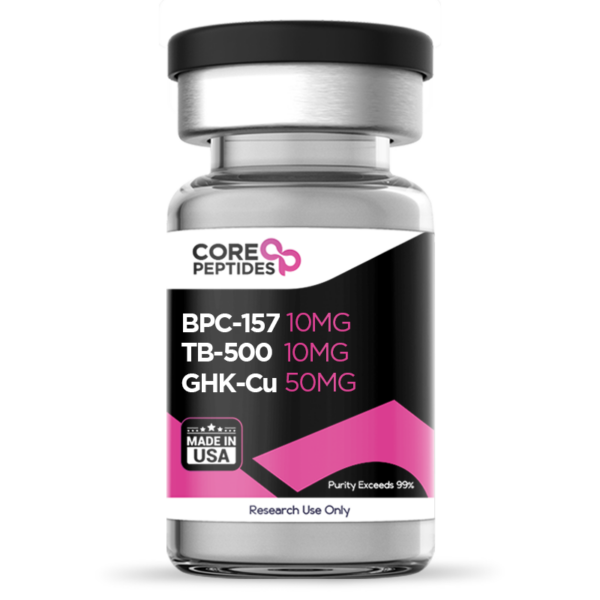
BPC-157 & TB-500 & GHK-Cu Peptide Blend
The BPC-157, TB-500, and GHK-Cu blend combines three highly researched peptides known for their overlapping and complementary roles in cellular repair, tissue regeneration, and inflammatory pathway regulation. By targeting distinct biological mechanisms—ranging from cellular motility to microvascular stabilization—this combination represents a multi-angled approach to tissue and structural repair research.
Core Chemical Profiles
| Peptide | Molecular Formula | Molecular Weight | Primary Synonyms |
| BPC-157 | $C_{62}H_{98}N_{16}O_{22}$ | 1419.5 g/mol | Body Protection Compound-157 |
| TB-500 | $C_{212}H_{350}N_{56}O_{78}S$ | 4963 g/mol | Synthetic Thymosin Beta-4 |
| GHK-Cu | $C_{14}H_{23}CuN_{6}O_{4}$ | 402.9 g/mol | Glycyl-L-histidyl-L-lysine-copper $2+$ |
-
Application: Laboratory Research Use Only
Synergistic Inflammation Management
In vitro and in vivo models suggest that these three compounds work via separate yet complementary paths to downregulate pro-inflammatory cascades.
-
TB-500 (TLR Pathway Inhibition): Research indicates that TB-500 elevates levels of miR-146a, a regulatory RNA molecule that acts as an internal brake on inflammation. This elevation suppresses key Toll-like receptor (TLR) signaling proteins (IRAK1 and TRAF6), preventing downstream NF-κB activation.
-
BPC-157 (Nitric Oxide & Cytokine Modulation): BPC-157 has been observed to reduce biochemical markers of neutrophil accumulation, leukotriene B4, and thromboxane B2. It promotes macrophage activity toward tissue resolution without directly causing immunosuppression. Furthermore, it interacts with the nitric oxide (NO) system to preserve microvascular integrity.
-
GHK-Cu (Macrophage & Alveolar Protection): In activated macrophage models, GHK-Cu lowers intracellular reactive oxygen species (ROS), restores superoxide dismutase (SOD) activity, and reduces the secretion of pro-inflammatory cytokines TNF-α and IL-6 by tempering NF-κB activation.
Enhanced Cellular Regeneration & Angiogenesis
Vascular formation and cell migration are critical prerequisites for efficient tissue repair. This blend targets multiple angles of vascular remodeling:
-
Endothelial Motility via TB-500: TB-500 binds to globular actin (G-actin), altering cytoskeletal structure to help endothelial cells migrate and form new vascular tubes. It simultaneously upregulates pro-angiogenic factors, including VEGFA, angiopoietin-2 (Ang2), and the Tie2 receptor through the Notch/NF-κB axis.
-
Vascular Stabilization via BPC-157: BPC-157 aids capillary sprouting by activating repair-associated signaling pathways like Egr-1 (and its regulator NAB2) alongside FAK–paxillin signaling. It balances NO production to ensure vessel patency and endothelial survival during stress.
-
Proliferation via GHK-Cu: GHK-Cu delivers bioavailable copper directly to injury sites, upregulating VEGF production, accelerating endothelial cell migration, and promoting rapid tube formation.
Advanced Collagen and Structural Repair
The restoration of mechanical strength in tendons, ligaments, and supporting structures relies heavily on uniform collagen deposition.
TB-500: Fibril Alignment & Tensile Strength
Preclinical models evaluating tendon fibroblasts exposed to TB-500 show collagen fibers that are more uniformly aligned along the ligament axis. Electron microscopy indicates larger collagen fibril diameters, which directly correlate with increased tensile strength and tissue stiffness.
BPC-157: Fibroblast Outgrowth & Survival
BPC-157 induces F-actin formation and activates focal adhesion signaling via the phosphorylation of FAK and paxillin. This mechanism accelerates fibroblast migration and spreading while protecting developing cells from oxidative stress at the injury site.
GHK-Cu: Tendon-to-Bone Integration
GHK-Cu enhances collagen synthesis specifically at structural junctions. Research models suggest improved bone formation around tendon cell grafts and higher overall cell presence within the graft matrix, leading to superior structural binding.
Section 621 Disclaimer
The BPC-157 & TB-500 & GHK-Cu blend is available strictly for research and laboratory purposes only. It is not approved for human consumption, therapeutic, or clinical use. Please review and adhere to our verified Terms and Conditions before completing your order.
Referenced Literature
-
Seiwerth, S., et al. (2021). Stable Gastric Pentadecapeptide BPC 157 and Wound Healing. Frontiers in Pharmacology, 12, 627533.
-
Maar, K., et al. (2021). Utilizing Developmentally Essential Secreted Peptides Such as Thymosin Beta-4. Cells, 10(6), 1343.
-
Maquart, F. X., et al. (1988). Stimulation of collagen synthesis in fibroblast cultures by the tripeptide-copper complex. FEBS Letters, 238(2), 343-6.
-
Santra, M., et al. (2014). Thymosin β4 up-regulation of microRNA-146a promotes oligodendrocyte differentiation. Journal of Biological Chemistry, 289(28), 19508-18.
-
Park, J. R., et al. (2016). The tripeptide GHK-Cu complex ameliorates lipopolysaccharide-induced acute lung injury in mice. Oncotarget, 7(36), 58405-58417.
-
Lv, S., et al. (2020). Thymosin‑β4 induces angiogenesis in mice with critical limb ischemia by regulating the the Notch/NF‑κB pathway. International Journal of Molecular Medicine, 46(4), 1347-1358.
-
Chang, C. H., et al. (2011). The promoting effect of pentadecapeptide BPC 157 on tendon healing. Journal of Applied Physiology, 110(3), 774-80.
-
Fu, S. C., et al. (2015). Tripeptide-copper complex GHK-Cu (II) transiently improved healing outcome in a rat model of ACL reconstruction. Journal of Orthopaedic Research, 33(7), 1024-33.
Medical Reviewer: Dr. Marinov (MD, Ph.D.), Chief Assistant Professor in Preventative Medicine & Public Health. Specialist in Evidence-Based Medicine, Nutrition, and Peptide Therapy Research.
Be the first to review “BPC-157 & TB-500 & GHK-Cu Blend (70mg)”
Related products
Reviews
There are no reviews yet.