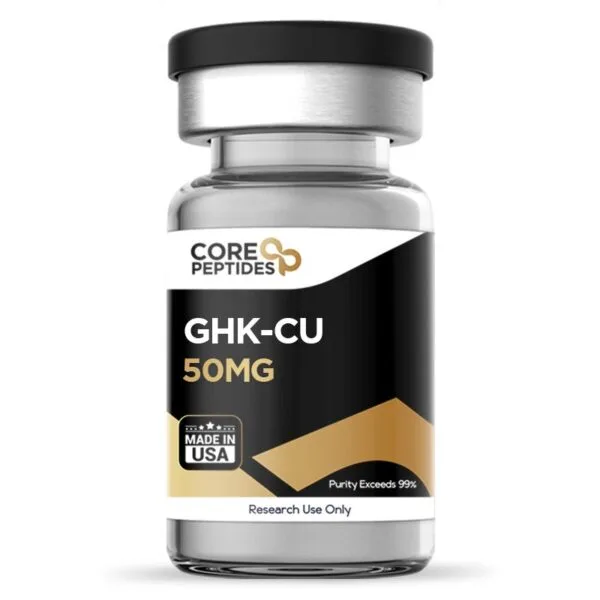
GHK-Cu (Copper) Peptide
GHK-Cu is a naturally occurring copper-binding peptide composed of 3 amino acids, i.e. glycyl-L-histidyl-L-lysine.(1) -Cu refers to the chemical addition of copper. GHK-Cu (Copper) is a small tripeptide found in plasma and reportedly releases at the time of injury. The concentration of GHK-Cu copper peptide 50mg declines with age. At 20 years, the average concentration of GHK-Cu of 200 ng/mL declines to 80 ng/mL by 60 years.(1)
Studies(4) have suggested when the plasma GHK peptide is added to the cell culture in nanomolar amounts; the peptide has the potential to induce a wide range of responses from growth stimulation to toxic cell differentiation. During the isolation of the peptide, researchers suggested that it exhibited potential chelating properties and might co-isolate with almost the same amount of copper ions and a fifth of the amount of iron found in the cells. When the peptide was incubated in the isolated cells as a bound complex with copper and iron molecules, maximal potential was reported.
Overview
Studies(5) have suggested that the peptide exhibits potential in gene expression and may to reset elements of the genome. By this potential mechanism, GHK-Cu peptide may restore impaired cells, including carcinogenic cells and COPD cells. GHK-Cu peptide has been researched for its potential across a variety of functions(1) including that it may tighten and reverse the thinning of aging skin structure, supporting the extracellular matrix, that it may restore the skin barrier and moderate texture, hyperpigmentation and lesions, may support tissue repair and mitigate inflammation, may stimulate increasing hair follicle size, may exert antioxidant properties and, finally, may exhibit gene restructuring potential.
Specifications
Molecular Formula: C14H23CuN6O4
Molecular Weight: 340.38 g/mol
Other Known Titles: glycyl-L-histidyl-L-lysine-copper 2+
Research and Clinical Studies
GHK Peptide Initial Research
This 1980s study(6) suggested the biological potential of the naturally occurring peptide in tissue repair. GHK peptide may host copper (II) ions due to possible copper affinity and may thereby stimulate the synthesis of collagen and increase the accumulation of total proteins and DNA at the injury site. Dermal wounded rats were used for this study. At the time of injury, the release of GHK peptide was induced. ‘Emergency response molecules’ were released from the matrix at the site of injury. Once released, GHK appeared to bind with Cu ions found in the blood and then stimulate the synthesis of decorin protein. Decorin protein is responsible for the synthesis of collagen and regulation of wound healing and anti-tumor defense mechanism. Further studies in the 2000s,(7) suggested that the GHK-Cu peptide hosts the potential to not only stimulate the collagen synthesis but also stimulate the production of tissue inhibitors, TIMP-1 and TIMP-2.
GHK Peptide and Tissue Repair
In this study,(8) the main aim was to understand the action of the GHK-Cu peptide complex when applied to the open wounds in comparison to zinc oxide. 18 New Zealand white rabbits were used for this study, divided into three groups: one group was presented with GHK-Cu, the second group with zinc oxide and third group with a placebo. Woulds were induced on each rabbit, and the rabbits were presented with the respective compounds for 21 consecutive days. After 21 days, it was suggested by the researchers that the group delivered with the GHK-Cu peptide complex appeared to exhibit increased healing compared to the group given zinc oxide or placebo.
In this study,(9) the main aim was to understand the action of the GHK-Cu peptide complex as compared to the helium-neon laser. Laser applications were measured at 1 J cm2 and 3 J/cm². 24 New Zealand white rabbits were used for this study, divided into three groups, and presented with respective concentrations of the GHK-Cu peptide complex and helium neon laser application. Experimental wounds were created on all the rabbits and all rabbits were studied for 28 consecutive days with the respective compounds. After the study, it was suggested by the researchers that rabbits studied with GHK-Cu peptide and higher concentration of the laser application appeared more receptive toward wound healing than the other group. The rabbits presented with GHK-Cu peptide exhibited an apparent decline in neutrophil counts and increase in neovascularization.
GHK Peptide and Metastasis
In this 1983 study,(1) the actions of the mixture of GHK-Cu complex and ascorbic acid (Vitamin C) on the growth of the sarcoma (tumor) cells was observed. 180 mice with cancerous growths were exposed to this mixture. Researchers suggested the mixture had the potential to induce a decline in the growth of carcinogenic cells in the subject mice. It was later reported by the researchers that GHK-Cu peptide complex exhibited some potential in increasing the expression of caspase and the associated genes, as well as gene expression associated with DNA repair. Specifically, this peptide seemed to suppress the growth of two types of cancer cells in experimental settings: SH-SY5Y neuroblastoma cells, which are a model for studying nerve cell behavior and pathology, and U937 histiocytic lymphoma cells, which are used to study the immune system’s response to cancer. Additionally, the peptide might have reactivated the apoptosis pathway, a type of programmed cell death crucial for removing faulty cells, as evidenced by activity in caspases 3 and 7, which are enzymes that play key roles in apoptosis. Conversely, in a study of non-cancerous cells, GHK appeared to promote the growth of NIH-3T3 fibroblasts, which are healthy cells often used as a standard model to examine cell division and growth.
GHK Peptide and Ulcers
This clinical study(10) was carried out in diabetic subjects with neuropathic ulcers. All subjects were enrolled in a standard wound care protocol, where only the subjects with a sharp ulcer wound or debridement were entered into this randomized, placebo-controlled clinical trial. The study was carried out using the GHK-Cu peptide complex gel. All subjects were divided into different groups, where one group was presented with the peptide gel, whereas others were given standard care with a placebo application. Following the study, researchers suggested that the subjects given the gel exhibited apparently elevated healing at 98%+. The gel complex appeared to have the potential to induce closure of 98.5% of plantar ulcers, whereas the control only reportedly induced 60.8% of ulcer healing.
Be the first to review “GHK-Cu (Copper) (50mg)”
Related products
Peptides
Reviews
There are no reviews yet.